Monday, August 26, 2013

Monday, August 19, 2013
Monday, August 12, 2013
Everything that could go wrong, and hopefully won't
As the launch date approaches (only 6 more days), the stress levels here at mission control (a.k.a. my room) are rising. There is still quite a lot to do before we'll be ready to launch. We can finally load weather reports from our landing prediction site (the site only predicts 180 hours into the future), so we've basically nailed down the launch site. I've also found a suitable helium dealer that will rent out 100 cu. ft. of helium for 2 days at the price of 70 dollars. A good price on a pressure regulator is yet to be found, and we may resort to using a party balloon valve, which would increase the filling time incredibly. The impending launch is always in the back of my mind, and sometimes I lie awake at night thinking of what there is left to do, what we might have forgotten, and everything that could possibly go wrong. So, as a way to vent, I've compiled a list of things that could terminate, ruin, or otherwise bring failure to our mission. I call it "Everything that could go wrong, and hopefully won't"
1. Premature burst of balloon
Explanation: This is the one that is the most disastrous, and unfortunately the most likely, event. The bursting would probably occur during the filling stage, as the wind could cause the partially filled balloon to strike a sharp object like a rock or a blade of grass, thus bursting or tearing a hole in the balloon. Alternatively, the burst could occur because the balloon got twisted up during inflation, stretching and bursting a small section of the balloon.
Prevention: In order to keep such an event from happening, we'll lay down either tarps or sheets on the ground, covering any sharp objects, and the balloon will be laid out flat to make sure it is not twisted during inflation. The balloon must be handled with caution, and all handlers will be wearing latex gloves to prevent skin oils from degrading the balloon fabric, and to prevent bursting by a sharp fingernail. Although I do not know how much the balloon fabric can take before being torn, I am going to assume it is very weak and take all precautions to ensure safe handling.
2. Faulty or non-configured electronics
Explanation: This one is caused mostly by forgetfulness, like forgetting to turn the GoPro or cell phone on, or forgetting launching the flight recording app. The whole mission would be pointless if we failed to record the video. Any failure with the cell phone would not be too disastrous, because there is a good chance of capsule recovery based solely on wind predictions.
Prevention: We will be checking and double checking and triple checking to make sure all of the electronics are powered on before we let the capsule fly away, as well as testing their functionality throughout setup.
3. Capsule or parachute disconnection
Explanation: There is a small chance of some sort of separation either parachute-to-balloon or capsule-to-parachute. The nylon cables themselves are very strong, however the capsule or parachute could separate through other means, like a poorly tied knot. A disconnection between parachute and balloon would result in a prematurely terminated flight, but a disconnection between capsule and parachute would result in a styrofoam box weighing 650 grams and containing $400 of equipment plummeting to earth at terminal velocity (not as cool as it sounds).
Prevention: Tie good knots. That's really all there is to it. A knot can be made tighter by soaking the nylon cord in water and then tightening again. We will most likely also attach safety lines in between components in case the primary lines fail.
4. Premature release
Explanation: Although this case is not very likely, it is a rather intimidating thing to think about your $150+ balloon and helium floating away without any payload, or your balloon and payload floating away without any electronics configured.
Prevention: Safety lines will be tied between the balloon and the helium tank during inflation, as well as between the capsule and the helium tank
5. Very unlikely events
Explanation: Some events are very low probability, but still possibilities. These events include, but are not limited to: Prevention from launch by local authorities, prevention of recovery by irritated farmer, water landing, mid-air collision with commercial airliner (yeah, not good), landing in Hanford Nuclear Cleanup Site (don't worry, our weather predictions say it will go the opposite way), or being mistaken for an alien spacecraft and confiscated (okay, that's never going to happen).
Prevention: Okay, so most of these things are either impossible or not predictable. However, to prevent a mid-air collision with any piloted craft, the capsule is outfitted with a radar reflector, and a NOTAM (notice to airmen) will be filed to alert pilots in the area of our launch. Any birds that are not outfitted with radar technology will just have to keep their eyes open.
Well that's the end of my list, now you know a little bit more of the risks we're taking in doing this mission. I think I understand now a fraction of a fraction of the stress that the people at NASA felt when putting a man on the moon. Check back tomorrow evening for another post. Better yet, just check every day this week, I'll be putting in quite a bit of time to prepare for the launch.
Saturday, August 3, 2013
A Short Update
Well, the weather balloon has arrived from Amazon.com, I still haven't opened it yet, but we will soon begin putting everything together. However I'm on vacation until the 10th so that's not going to happen until I get back. This gives us only one week until the launch, which we set for the 17th of August. The exact location will not be determined until we can get weather reports for that day, so we'll be waiting on that too. Fortunately, our weather predicting service gets reports 180 hours in advance, so we'll have the whole week to set our final launch location. The last thing to buy will be the helium, after I find out where I can get the best deal, either from a welding supply, a gas dealer, or a party place. That's all I have for you today, there won't be any posts from me until probably the eleventh, where I hope to make posts every day until the launch.
Monday, July 29, 2013
Even More Progress
Balloons!!! (well, actually one balloon)
So, we finally got far enough in our project that we were able to buy a balloon! We decided to go with the $60 20 ft 600 gram Professional Weather Balloon sold by Aether Industries. The other option was a 1200 gram balloon for $105, but the smaller one is more suited to our purpose, although we may suffer a loss in altitude as a result. Predictions put us around 90k ft, but that's all they are: predictions. The actual altitude may go up or down from that. We figure that the balloon will need about 70 cubic feet of helium to achieve 2kg of lift and 4.94 m/s rate of ascent. We haven't yet lined up a helium dealer, but I will start calling all the local places to find the best price. When the balloon finally does arrive, we have to insert a short length of PVC and zip tie it in place so we can attach the payload lines to it. We'll be sure to take a video so you can see how it's done as well as see what the balloon looks like. When handling the balloon, we will have to wear latex gloves to prevent any oils from degrading the balloon and causing a premature burst.
Near Space Capsule
Yeah, the only thing that's changed here is we painted it black (Rolling Stones' "Paint it Black" plays in the background) and made a better fitting mount for the GoPro. We also purchased a GoPro Battery BacPac and ran a test, it added about 90 minutes extra battery life, which should give us plenty for the entire mission. I should start calling it the "GoBroke" because that's basically what I'm doing for this enterprise. GoBroke. And instead of "Be a Hero" as the tagline, it'll be "Spend All Your Money Sending Me to Near Space Without the Certainty of Getting Anything Back."
Calculations
I don't really feel like going into much detail about how we calculated ascent rates and stuff like that, but I'll tell you it did involve quite a bit of metric/imperial unit conversion. For those of you who don't know, imperial is the set of units we use here in 'Murica. Our calculations required very involved and in-depth operations such as Googling something like "ascent rate calculator" or "burst height calculator", plugging in a bunch of numbers, and pressing "calculate". In all seriousness, though, it was no easy task to juggle a bunch of variables, units, and ideas around and come up with results. For example, when calculating the lift we would need, we searched through different resources to find suggestions for lift/weight ratios or positive lift. One resource said to have a 3:2 lift/weight ratio, while another said to have 4 or 5 lbs positive lift, and yet another said to have 500g positive lift. We decided to trust the 500g measurement; The example presented on the site was a situation very similar to ours.
Weight n'stuff
The capsule ended up weighing 520 grams, and 780 grams if you add the chute, the radar reflector, and the nylon rope. The balloon, of course, weighs 600 grams, and we decided to give the capsule a 620 gram positive lift to bring the total to a nice, round, 2 kilograms. Because 1 cubic foot of helium can lift 28.2 grams, we will need about 70 cubic feet of helium. (are you double checking my math? because trust me, I did it right). That brings us to a nozzle lift of 1400 grams (lift of balloon considering weight of balloon). This can be accomplished using a counterweight of 1400 grams and filling the balloon until it just lifts the counterweight.
Well, that's all I have for you for now. Sorry, no media today. Yes, I realize it's been two weeks since the last post and things are starting to get redundant. But it's all coming together pretty quick. I'll probably have some more interesting, more humorous things to come that'll fill up the time between finishing and the launch date. As always, check back often, and don't hesitate to drop us a line at nearspace13@gmail.com.
Tuesday, July 16, 2013
Some Progress...
The Near Space Capsule
This week we made some purchases both online and at a couple stores, and began construction on the near space capsule. Our shopping list included: PVC couplings, duct tape (very useful), aluminum tape, 48" parachute made of ripstop nylon, 100 feet of 2mm nylon rope, and a couple blocks of floral foam. The PVC couplings are going to be used inside the balloon neck to provide a structure to which we can attach the rope and parachute. We'll do that when we finally get the balloon. The duct tape is, of course, used for sticking stuff together (yes, this is a technical term). The aluminum tape has a unique purpose. The aluminum surface of the tape works great to reflect radar signals, and with it we built the aptly named "radar reflector". The parachute was purchased from rocketchutes.com. Yes, we got the biggest one they had. For the cables, we got nylon rope from REI. We're not sure of the exact tensile strength, but it's definitely strong enough for our project. The floral foam proved to be a suitable filler for the capsule interior: it's stiff, easy to cut, and lightweight. Not to mention inexpensive, too.
Anyway, we were able to do most of the construction of the near space capsule. This mostly involved cutting holes in the box and the floral foam, as well as duct taping the whole thing (you know, because duct tape makes everything stronger). All that's left for the capsule is to figure out the rigging of the nylon rope and to make sure the GoPro will stay secure (wouldn't want it falling out mid-flight).
We also constructed a radar reflector so that the local ATC or any radar-equipped device can track it in the air (hopefully). We wouldn't want it to get sucked up in the turbine of a 747. I don't feel like explaining how exactly the radar reflector works, but here's a great video by Smarter Every Day and Minutephysics that does a good job of explaining it.
Well that's about it. Our launch date has been set (tentatively) for either the 10th or 17th of August. I've attached pictures and videos at the bottom of this post of our progress. Again, be sure to check back with us frequently.


Monday, July 8, 2013
Update: a small change of plans
Location
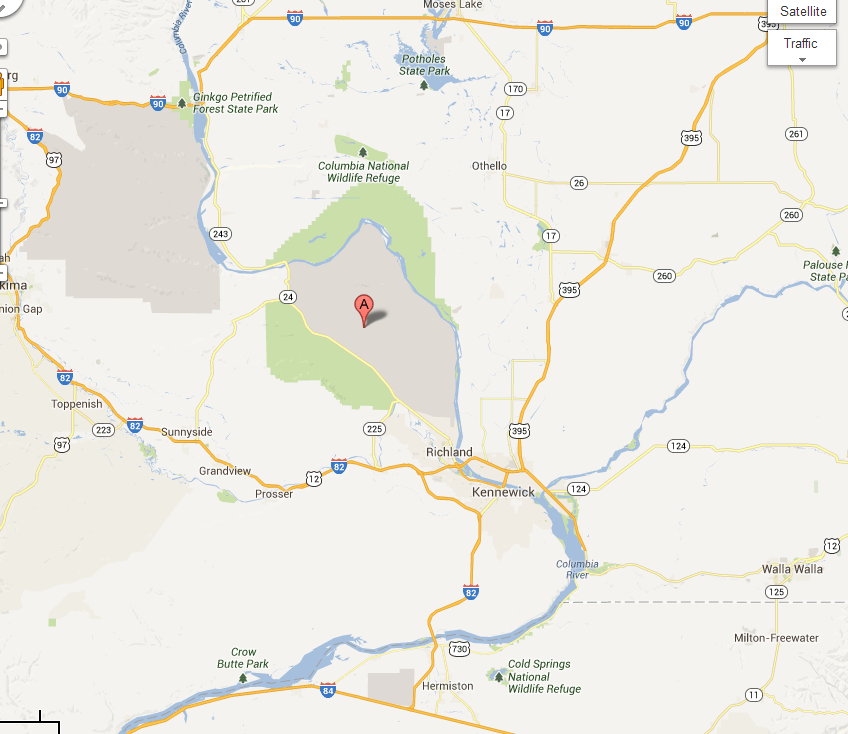
You know how I posted about Bend, Oregon being our launch site? Yeah, well that's changed (possibly). Recent research has yielded a new possible site which is better than Bend. And although it does have some obstacles (only a few rivers and a nuclear cleanup site, no big deal), the terrain is much more ideal (mostly farmland, i.e. easy retrieval) and the cell coverage is much, much, much better. The area which we are looking at is South Central Washington, landing hopefully near Kennewick. And yes, that does mean that the nuclear site to which I am referring is Hanford, the one which manufactured the plutonium for the bomb detonated in Nagasaki. It is also the most contaminated nuclear site in the nation (yeah, that may be a problem). It's okay, though, so long as we land in the farmland around the site and not in the site. I do not want to have to talk to federal officials about why I have landed a craft in their nuclear site.
 |
| Where we want to land |
 |
| Where we absolutely do not want to land |
The fact that there is a federal site may also explain why a bunch of farmers can get 4G cell coverage. Anyways, the coverage here is superior to that in Bend, which is necessary for recovery. The launch site is also quite a bit closer to Portland as well.
A few extra expenses
We are going to have to buy some more pieces of equipment which we hadn't originally planned on buying. One is a GoPro Battery BacPac (their spelling, not mine) which will get us enough battery life to last the whole journey. On it's own, the stock battery will last about 2 hrs (estimated length of flight: 2 hrs 15 min). The BacPac should double the battery capacity, however it may cost around $50. We also need to purchase a 32GB Sd card which adds about $25 but can record 4 hrs of HD video. Another expense we had not thought of is a gas pressure regulator for the helium. It is highly recommended by near space professionals that one is used in order to prevent popping of the balloon. I do not know yet the expense of this one, however I did see an absurdly priced regulator and filling tube for $60. I will hopefully be able to borrow or rent one. On a more positive note, I was able to find a parachute for only $25 which is less than I planned on spending. Oh, and we decided to only buy one balloon. If it pops, we purchase another and postpone for a week. Peace of mind isn't quite worth $80.
Progress update
Not much has changed since the last post. However, we plan on completing the capsule this week after ordering parts. If we are actually able to get some work done this week, we'll have another update on the blog soon. As always, if you have any comments, questions, or anything else you want to tell us, don't hesitate to email us at nearspace13@gmail.com (seriously, I created an email solely for this purpose and the inbox is quite empty) Be sure to check back on the blog frequently, more stuff will be happening as the launch draws ever closer.
Subscribe to:
Posts (Atom)